Today we are grateful once more for the explosion of creativity that is ‘The Many’, who have offered this beautiful poem.
Advent day 15, what are we waiting for?

Today we are grateful once more for the explosion of creativity that is ‘The Many’, who have offered this beautiful poem.
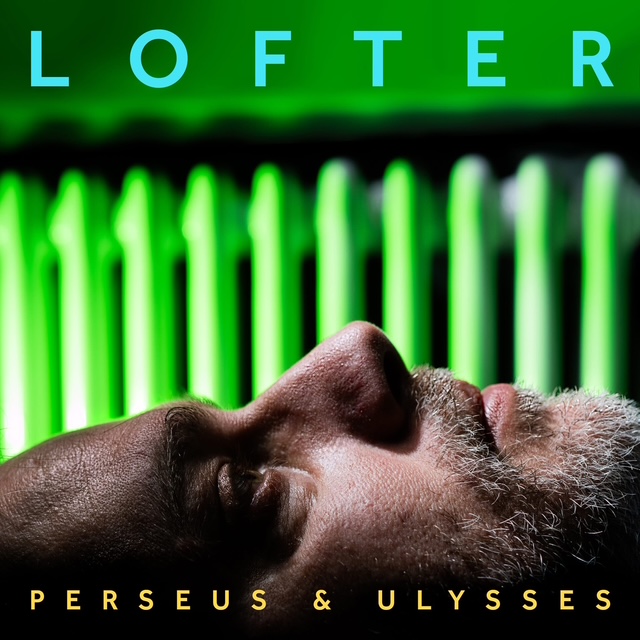
I’ve been living with this album on almost constant replay for a week now. It’s such a privilege to hear it before any official release and to be asked by Ant Clifford to review it!
Ant will have to correct me but looking at my music collection, it seems I’ve been listening to Lofter since 2016 when Proost made the Lofter back catalogue available. Since then every new release has been eagerly anticipated.
But enough of my reminiscing. Let’s get to the music.
There are some typical Lofter recurring themes in the lyrics – loss, unfulfilled love, struggling with the past, feeling trapped and unable to move forward – but as ever it’s never maudlin or without hope. Certainly not. More than that though, Ant has probably never been more open with his emotions and feelings or his ADHD condition (the piano driven ‘4AM’ which was co-written with Mike Rutter or the more poppy ‘Crash bang’) and this has given room to some of the finest, most beautiful, most emotionally moving songs Lofter has ever produced.
At every level the musicianship is fabulous – that’s not surprise of course; Ant is a truly gifted musician and he’s surrounded himself with a group of co-writers and collaborators who make the sum beautiful to listen to. You’d expect the guitar-work to be top draw (which it is) but there’s use of some really interesting synths to add layers. When Lofter introduce xylophone-sounding synths and horns (a nod to Lofter’s Yorkshire home perhaps) the production reaches an astonishing peak which, for me, really moves my heart. There’s plenty of pop-sensibility on show too – not least ‘Tidal Wave’ which could easily be found on a Sophie Ellis-Bextor album!
I’ll pick out a few highlights in an album genuinely full of them.
Co-written with Adam Hayes, ‘Lasting Light’ is a song about a friend who knew they were going to die and the singer finding out too late. The acoustic, undistorted finger picked guitars are the foundation of this delicate song but the percussion and synths create a gentleness that you find yourself drifting along with as you listen to the depth of the words:
“Didn’t hear your pain
‘Coz your smile drowned it out
And I want you to know
You to know
With the time that’s left
As long as I draw breath
Your light is here to glow
Here to glow”
I mentioned ‘Crash Bang’ earlier and it’s a stand out track if only because it’s the first time I’ve heard ‘neurodiversity’ in a song lyric! But it’s a wonderful, inspiring danceable tune celebrating the challenges and joys of ‘difference’. It’s got a such a catchy rhythm and builds to quite the most uplifting crescendo.
“Crash bang emotionally
So many things to feel
So many things to be
Our neurodiversity
Autism for you
ADHD for me”
Which leads me to ‘After you left’. Some of you may have heard this already as Proost got an early preview a month or so ago. It may also be the finest song Ant has written. A song about being left behind and then eventually joining your loved one after death, Ant’s vocal range is used to full effect to evoke the depth and power of the track.
“Before our life together was full
But it’s empty now you’re gone”
An extended bridge after verse one introduces piano, subtle strings and percussion creating a delicacy – a ‘touch’ that invites you deep into the soul of the song.
Ant cuts back again for the second verse. There’s very little musical accompaniment to the vocals which are used brilliantly to express such emotion, before the horns, an instrument used to such emotive effect throughout this album, re-emerge to elevate the song to another level altogether.
It’s an incredible song of such depth and power.
“I can feel the end slowly
Peaceful thoughts take my mind
Like I can smell new air fresh and free
Makes me happy to leave this part behind”
Following this track with the upbeat ‘Tidal wave’ is a master stroke. Ending with the lullabye-esqe ‘Little Life’ is perfect.
The whole album is a great success and comes highly recommended from me.
You can listen and download the album here
Rob Hewlett

One of the delightful things about our Proost project is that it enables us to walk the edges and find others that are doing the same. We try to gather some of this edge walking via our two podcasts- one that has a more general focus (and includes trying to do Proost ‘business’ out in the open), the other one gathering poets and poetry- as this seems to have always been a strong and important strand of what we are about.
Today I was delighted to listen and share this conversation;
Where does poetry go? What is it for? How might it be used in the service of justice, peace and reconciliation? How does this relate to spirituality?
In this episode, our Talitha talks to the poet, musician and activist Samara Pitt about her practice, her songs and her love of words. In particular, she describes a process of turning poetry into song – an almost magical process…
Samara describes herself like this;
Samara is a 7th generation coloniser-inheritor living on the unceded land of the Wurundjeri Woirurrung people in the hills outside of Naarm/Melbourne.
She has lived and worked in several different intentional communities, most recently at Gembrook Retreat where the community invites people on to the land to encounter God in creation and to equip each other to live a soulful life.
She loves singing, singing with others, and putting music to words that help us listen more deeply to Country and to soul. Drawing on the liturgical tradition of sung refrains as a congregational response to the reading of a psalm, she has just started to compose short songs based on the repetition of short phrases, designed to help us dwell with the emotion and beauty of words and harmonies. They are also a grateful tribute and offering to the writers.
You can find more of Samara’s work – and support it – here.
Here is Samara’s account of her poetry choices for this episode.
Shaun Tan is one of my favourite writers and illustrators working in these lands now called Australia. His books are haunting and beautiful. and help me to look at the ordinary through the lens of wonder and imagination. This is taken from his book Tales from the Inner City which explores the mythic presence of the more-than-human world in the midst of our cities.
The lyrics come from Kerri ní Dochartaigh’s book ‘Thin Places’, a mix of nature writing and Troubles memoir about growing up in in the midst of violence in Derry and the role of nature in helping her find peace and healing.
Gout Gout is an up and coming Australian sprinter who gave the most poetic statement I’ve ever heard from an athlete in a press conference, when he was asked if he still feels normal. I found another slam poetry style quote from him about how he ‘steps light but presence heavy’, and then added my own line imagining the cycle of preparing for, running and coming down after races.
I found these lines in a book by Chris Anderson called ‘Light when it comes’. Based on the spiritual practice of ‘examen’, these words suggest that we turn to face darkness rather than flee from it.

As part of our Mycelium weekend in Glasgow (the weekend of the 4th of October – more details here.) we will be hosting a ceilidh at Kings Park Parish Church. It will be a free, bring your own bottle affair- with donations welcome to help with our costs
There will be dancing (of course) led by the wonderful Mactalla Ceilidh Band
Along the way, there will be storytelling, poetry and song as well.
At a time when many of us feel assailed by so much conflict and division, perhaps a ceilidh might itself be a subversive act? Here is a video made at one of Mactalla’s events- with added poetry by our own Chris Goan.
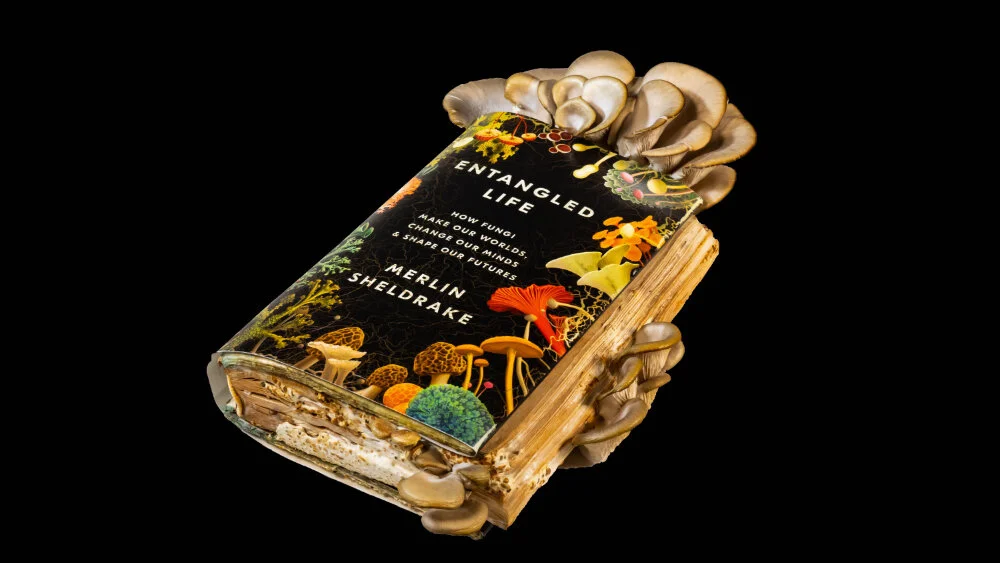
If there is one book that has helped those of us not within the academic world understand some of the mysteries of the wood wide web, it is this one.
Here is Merlin Sheldrake giving his own introduction.
Come and be part of the Proost mycelium event.
Date: 3rd October 2025 (6:00 PM) to 5th October 2025 (4:00 PM)
Location: St Oswald’s Episcopal Church, King’s Park, 260 Castlemilk Rd, Glasgow G44 4LB
Hosted by: Proost, in partnership with local Episcopal and Church of Scotland Churches


New pod is out! This time, a lovely conversation between two good friends about the poetry of the much-loved writer Mary Oliver.
If you are not familliar with her work this pod will be a great introduction, but even for those of you (like me) who know many of her poems, this chat will open much more to you.
The chat is hosted by Proost’s own Ali Matthew, speaking to her friend Liz Hoare.
Liz recently retired from teaching spiritual formation at Wycliffe Hall, Oxford where she was also Dean of women students.
Ordained in the Anglican Church, her parish ministry has been in the rural Church in the north of England. She now works part-time at St Bede’s Pastoral Centre in York as a member of the ecumenical spirituality team with a focus on spiritual direction. A life-long reader of poetry and novels, she loves being outside in the garden or walking the family dog. Liz is married with a young adult son.

Here is part 2!

Imagine stepping away from the digital world and immersing yourself in the raw beauty of a tiny Hebridean island. What if you went there with a purpose, and deliberately called it a ‘pilgrimage’? What if you split your time there between laughing with friends and times of deep silence? What impact would such a time make in your life? Would it just be a nice interlude, or might it start to shape you in more profound ways? How might relationships that you formed there impact survive back in the real world, both in terms of the divine and profane?

On our most recent retreat, back in May, I took the opportunity to ask some of my friends these questions. We went to the island of Lunga, part of the Inner Hebrides, just the other side of the ‘Grey dogs’ tidal race from its more famous neighbour, Jura. This remote location, with its sense of wild beauty, provided the perfect backdrop for our trip, and this time, the sun was shining throughout. As we explored the island, we were reminded of the rich Celtic heritage and the spiritual significance of these islands – and how they connect us with an older spiriuality that was always connected to earth in ways that we have largely forgotten.

The retreat was more than just a getaway; it was a gathering of friends, old and new. We shared stories, laughter, and deep conversations, creating a temporary community that felt like home. I have often reflected on how these people, some of whom I see only once or twice a year, have become for me a kind of Anam Cara- deep soul-friends of the kind that ‘know’ me in ways that it is impossible to fully describe. Some of this is fostered by the island – the exposure and shared need for each other it places in us but also by the raw uncouth toilet humour that has two superpowers – it is very funny, but also strips out all pretense.
These video’s were recorded in a hurry, right at the end of our trip, as I it felt like an imposition, an indulgence. I am very grateful that some of my friends were gracious enough to take part.
There are two ways to watch/hear the chat…
By podcast
Or I uploaded the vid to Youtube here

You may remember previous articles and even podcast interviews with Dr. Katie Cross, who has been undertaking research trying to understand paths taken by people who leave church- the meaning they make and find, the connections they still seek and so on.
Katy is now towards the end of her research, and is entering a ‘creative response’ stage. There are a few ways you can be involved, but the first meeting on-line is Tuesday the 29th at 6PM. If you are on your own journey beyond church, but feel like understanding this better in community then this might be just the place for you.
There are two ways folk can take part:
As above, the first group is meeting on Tuesday 29th July at 6pm on MS Teams.
We hope that Katie will be able to join us on the Proost podcast soon to collect together some thoughts and conclusions about this very important research.
Why do I think this chat is so important? As with this post, there is lots of chat just now about what is emerging in terms of organised religion in the UK. After a long decline, some say (on currently very limited evidence) that there is a ‘quiet revival’ taking place here, with young people, and young men in particular, flocking back into Churches. If this is true – if we are seeing a reversal of the decades-long social trend away from organised religion – then it seems important to understand this and the social forces that might be at work.
On the other hand (and at present I remain in this camp) if this research turns out to be flawed, we also need to understand why so many people within the Church have seized on it with such uncritical enthusiasm.
Meanwhile there is another conversation that is taking place – for example in Katy’s research – with those who have been activists, leaders and pioneers within the church, but no longer feel able to be part of formal religious structures. What happened ot these people? Where are they finding meaning? How might they shape and influence what happens next?

Even as I write this, I think too of dear friends who continue to work WITHIN the Church, to carry forward acts of grace and mercy, to serve an aging population with critical needs, to run food banks and toddler groups, to set up refugee support groups and to make simple beautiful acts of worship that enable people to deepen their spiritual experience. I think how exhausted some of them are, and how abandoned the conversation above makes them feel…
Things are changing, shifting, shrinking and unfolding at the same time. This has always been the case, but it does feel like we are standing on anther threshold. Whilst we mourn what is lost, we can also be excited about what will come.
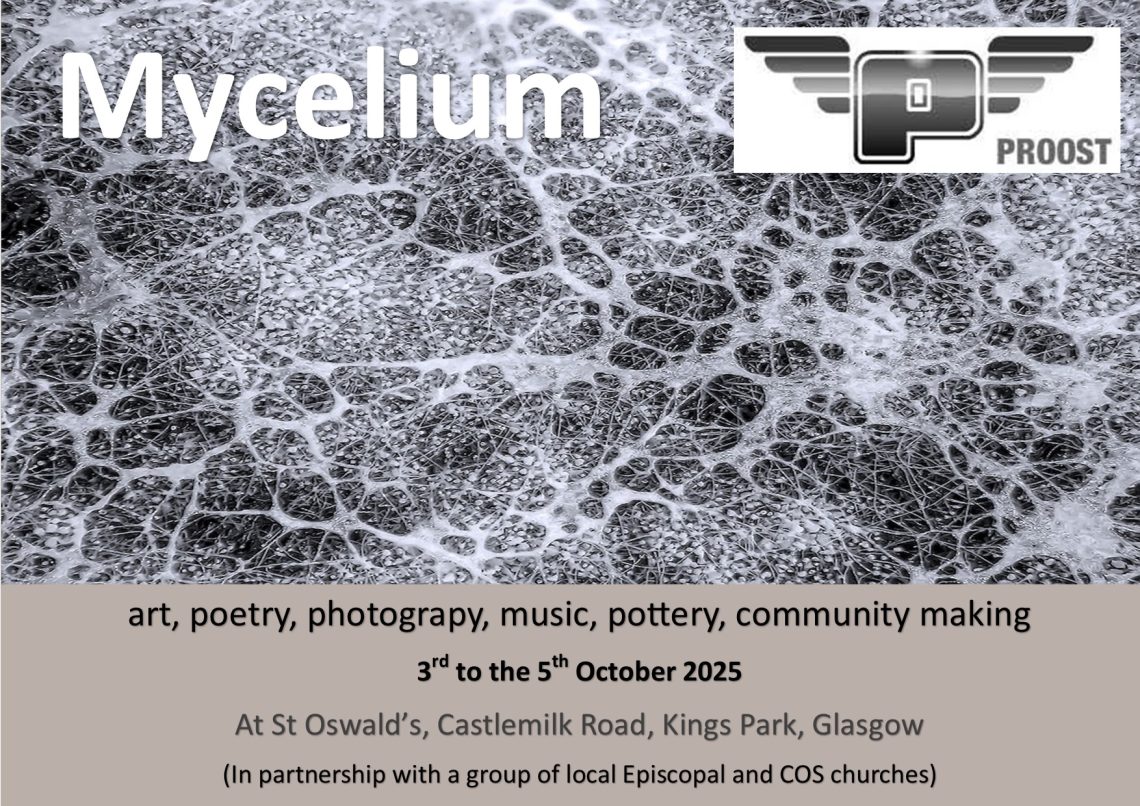
We are going to be using this blog space to post material related to the theme of our Proost meet-up in Glasgow this October. Consider it inspiration for your own art making and imagining.
Today, lets talk about forest…
 Spotify