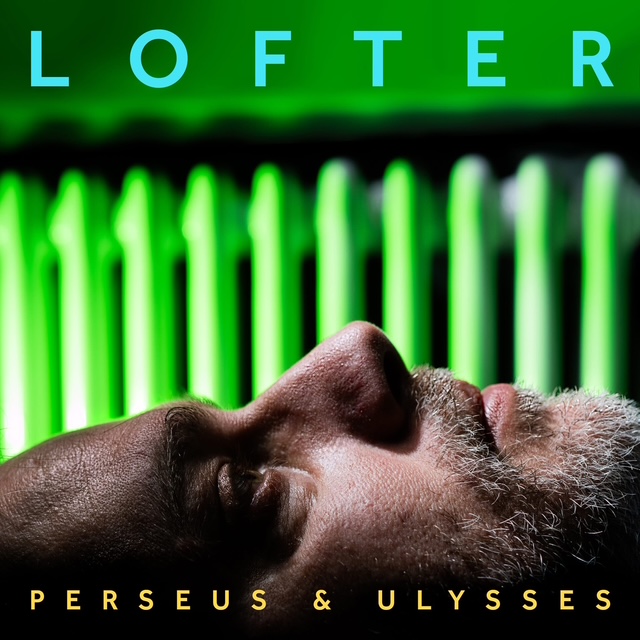
Today we have a treat – a brand new song from our friend Ant and his band Lofter. This song was written and recorded in the last couple of weeks and we love it.
Today we have this magical photograph, shared by artist Raine Clarke, but taken by her husband high in the Scottish mountains. What you are seeing is a phenomenon known as a Brocken Spectre, with Gordon’s shadow at the centre of the halo effect. Plus that gorgeous inversion layer of cloud. It is the ordinary extraordinary. The brilliance inside each living moment–what the Celts used to call the light within light and the love inside love.
We will pair this picture with a beautiful song from The Brilliance.
I’ve been living with this album on almost constant replay for a week now. It’s such a privilege to hear it before any official release and to be asked by Ant Clifford to review it!
Ant will have to correct me but looking at my music collection, it seems I’ve been listening to Lofter since 2016 when Proost made the Lofter back catalogue available. Since then every new release has been eagerly anticipated.
But enough of my reminiscing. Let’s get to the music.
There are some typical Lofter recurring themes in the lyrics – loss, unfulfilled love, struggling with the past, feeling trapped and unable to move forward – but as ever it’s never maudlin or without hope. Certainly not. More than that though, Ant has probably never been more open with his emotions and feelings or his ADHD condition (the piano driven ‘4AM’ which was co-written with Mike Rutter or the more poppy ‘Crash bang’) and this has given room to some of the finest, most beautiful, most emotionally moving songs Lofter has ever produced.
At every level the musicianship is fabulous – that’s not surprise of course; Ant is a truly gifted musician and he’s surrounded himself with a group of co-writers and collaborators who make the sum beautiful to listen to. You’d expect the guitar-work to be top draw (which it is) but there’s use of some really interesting synths to add layers. When Lofter introduce xylophone-sounding synths and horns (a nod to Lofter’s Yorkshire home perhaps) the production reaches an astonishing peak which, for me, really moves my heart. There’s plenty of pop-sensibility on show too – not least ‘Tidal Wave’ which could easily be found on a Sophie Ellis-Bextor album!
I’ll pick out a few highlights in an album genuinely full of them.
Co-written with Adam Hayes, ‘Lasting Light’ is a song about a friend who knew they were going to die and the singer finding out too late. The acoustic, undistorted finger picked guitars are the foundation of this delicate song but the percussion and synths create a gentleness that you find yourself drifting along with as you listen to the depth of the words:
“Didn’t hear your pain
‘Coz your smile drowned it out
And I want you to know
You to know
With the time that’s left
As long as I draw breath
Your light is here to glow
Here to glow”
I mentioned ‘Crash Bang’ earlier and it’s a stand out track if only because it’s the first time I’ve heard ‘neurodiversity’ in a song lyric! But it’s a wonderful, inspiring danceable tune celebrating the challenges and joys of ‘difference’. It’s got a such a catchy rhythm and builds to quite the most uplifting crescendo.
“Crash bang emotionally
So many things to feel
So many things to be
Our neurodiversity
Autism for you
ADHD for me”
Which leads me to ‘After you left’. Some of you may have heard this already as Proost got an early preview a month or so ago. It may also be the finest song Ant has written. A song about being left behind and then eventually joining your loved one after death, Ant’s vocal range is used to full effect to evoke the depth and power of the track.
“Before our life together was full
But it’s empty now you’re gone”
An extended bridge after verse one introduces piano, subtle strings and percussion creating a delicacy – a ‘touch’ that invites you deep into the soul of the song.
Ant cuts back again for the second verse. There’s very little musical accompaniment to the vocals which are used brilliantly to express such emotion, before the horns, an instrument used to such emotive effect throughout this album, re-emerge to elevate the song to another level altogether.
It’s an incredible song of such depth and power.
“I can feel the end slowly
Peaceful thoughts take my mind
Like I can smell new air fresh and free
Makes me happy to leave this part behind”
Following this track with the upbeat ‘Tidal wave’ is a master stroke. Ending with the lullabye-esqe ‘Little Life’ is perfect.
The whole album is a great success and comes highly recommended from me.
As part of our Mycelium weekend in Glasgow (the weekend of the 4th of October – more details here.) we will be hosting a ceilidh at Kings Park Parish Church. It will be a free, bring your own bottle affair- with donations welcome to help with our costs
Along the way, there will be storytelling, poetry and song as well.
At a time when many of us feel assailed by so much conflict and division, perhaps a ceilidh might itself be a subversive act? Here is a video made at one of Mactalla’s events- with added poetry by our own Chris Goan.
You may remember previous articles and even podcast interviews with Dr. Katie Cross, who has been undertaking research trying to understand paths taken by people who leave church- the meaning they make and find, the connections they still seek and so on.
Katy is now towards the end of her research, and is entering a ‘creative response’ stage. There are a few ways you can be involved, but the first meeting on-line is Tuesday the 29th at 6PM. If you are on your own journey beyond church, but feel like understanding this better in community then this might be just the place for you.
There are two ways folk can take part:
By attending online workshops to discuss prompts and reflect together. You can sign up here to join in.
By writing up your own reflections in your own time, and emailing these to Katie here.
As above, the first group is meeting on Tuesday 29th July at 6pm on MS Teams.
We hope that Katie will be able to join us on the Proost podcast soon to collect together some thoughts and conclusions about this very important research.
Why do I think this chat is so important? As with this post, there is lots of chat just now about what is emerging in terms of organised religion in the UK. After a long decline, some say (on currently very limited evidence) that there is a ‘quiet revival’ taking place here, with young people, and young men in particular, flocking back into Churches. If this is true – if we are seeing a reversal of the decades-long social trend away from organised religion – then it seems important to understand this and the social forces that might be at work.
On the other hand (and at present I remain in this camp) if this research turns out to be flawed, we also need to understand why so many people within the Church have seized on it with such uncritical enthusiasm.
Meanwhile there is another conversation that is taking place – for example in Katy’s research – with those who have been activists, leaders and pioneers within the church, but no longer feel able to be part of formal religious structures. What happened ot these people? Where are they finding meaning? How might they shape and influence what happens next?
Even as I write this, I think too of dear friends who continue to work WITHIN the Church, to carry forward acts of grace and mercy, to serve an aging population with critical needs, to run food banks and toddler groups, to set up refugee support groups and to make simple beautiful acts of worship that enable people to deepen their spiritual experience. I think how exhausted some of them are, and how abandoned the conversation above makes them feel…
Things are changing, shifting, shrinking and unfolding at the same time. This has always been the case, but it does feel like we are standing on anther threshold. Whilst we mourn what is lost, we can also be excited about what will come.
Here is a quick update on the Proost meet up for artists in Glasgow. First, the key details;
PROOST MEET UP, 2025
Date: 3rd October 2025 (6:00 PM) to 5th October 2025 (4:00 PM) Location:St Oswald’s Episcopal Church, King’s Park, 260 Castlemilk Rd, Glasgow G44 4LB
Hosted by: Proost, in partnership with local Episcopal and Church of Scotland Churches Cost: The gathering is free, with the aim of making this gathering as accessible as possible for all. Accommodation: Informal hosting options are available for those who need them, and we’re happy to provide guidance on nearby accommodation options to help you make your stay as comfortable as possible. Let us know how we can assist you!
WHAT IS IT ALL ABOUT?
Many of you will remember Proost as it used to be- a publishing platform established on the edge of what we used to call ’emerging church’ or ‘missional groups’ or ‘alt worship’. It gathered a community of creatives who made poetry, art, video, music, liturgy and much more. For many of us, it gave a sense of belonging and connection – and ways to collaborate with other artists in both gathered and dispersed events. We live in different times now, but if anything, creatives need these connections more than ever.
We need art that engages, that challenges, that allows us to go deeper.
We need to hear from people who are otherwise marginalised.
We need to speak of justice and peace, so challenge where appropriate.
We need to take allow our art to connect with the deep spirituality of the earth.
The landscape of faith and culture has changed a lot in the decades since Proost first came on to the scene. Communication technology has made publishing easier, yet at the same time so much harder because of the sheer volume of content being produced. Funding streams and generating income is a massive challenge. Against all this, we have a powerful tool called community.
This is our dream for a new Proost- the means by which we combine our voices, our creativity and our resources to transcend the limitiations imposed by our context in service of justice. We think this is a holy pursuit, made ever more urgent by the crises gathering around us- wars, climate breakdown, inequality and political/economic impotence.
Much of this discussion has been taking place via two podcasts…
… and we have made a start with some collaborations around Advent and Lent.
But we feel that community also needs to make physical connections. We need to come together in one place, to share stories, to make plans and art together.
WHAT WILL WE DO?
The idea is simple- choose a theme and then invite people to respond to it using their art – music, poetry, painting, dance, pottery, photography, animation, video – or anything else.
We will make space for as many contributions and expressions of creativity as we can comb together in the form of installation or performance. The only limitation is that you need to bring those contributions in person!
We are so grateful to St Oswald’s Episcopal Church (King’s Park, 260 Castlemilk Rd, Glasgow G44 4LB) in partnership with local Episcopal and Church of Scotland Churches for generously hosting this weekend.
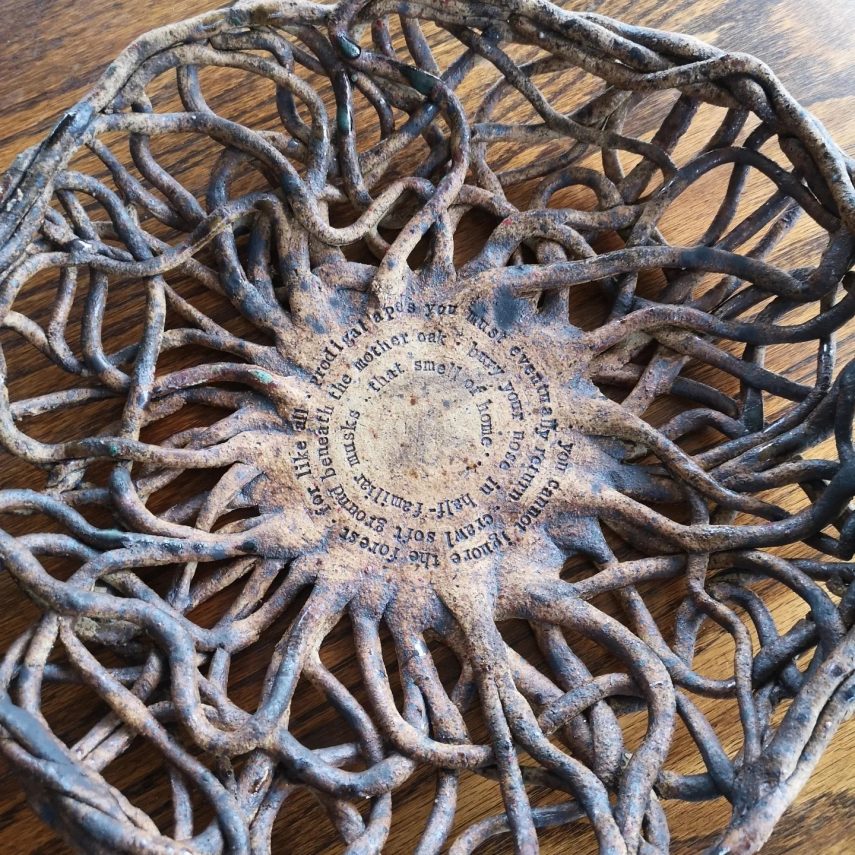
Installation space will be in and around the St Oswalds. (This will include a large mushroom-related ceramic offering!)
Performance opportunities will be via 1. A great big Ceilidh on Saturday night – dancing, hopefully interspersed with all sorts of other poems, songs and stories. 2. Sunday afternoon event. Both will be open to local people.
We want to keep Saturday day-time for discussion and chat amongst Proostians – working out together what seems important, and how this project might progress. There will be themed discussions led by different members of the team.
WHY MYCELLIUM?
This is the theme we have chosen for our meet up. Some of the reasons for this will already be in your heads, but here are some ponderings that might help unleash your own creative responses.
Soil science is advancing rapidly – we now need to stop thinking of soil as just inert dirt. It might be more accurate to regard it as a living entity all on its own – but if that is a little fanciful surely we need to understand that it is a complex ecosystem- one which almost all other land based life on the planet depends upon. Without soil, we die. Crucially, the role of mycelial networks in connecting, communicating and making communalities is increasingly being understood to be so much more important than previously thought.
Mycelium is the way that trees ‘talk’ to one another. Think about that- one life form relies upon another lifeform in order to share nutrients, warn of disease and so much more.
We modern humans tend to think about the natural world as being characterised by competition, the elimination of weakness and ‘survival of the fittest’. We have taken Darwinian ideas, misunderstood them and used them to justify our economics, our politics – even our spiritualities. The more we understand about mycelium, the more we need to think again.
Perhaps the ‘survival of the fittest’ might better be understood to mean that we survive best when we seek to fit with our context – when we seek connection and community.
What are we connecting with? Does mycelium only represent a way to understand human interrelatedness – with both each other and with the wider natural world? I would argue however that we might consider this connection to be much deeper than that.
These ideas have always been at the heart of the Christian story, not least the mystical traditions and the Celtic wisdom traditions, both of which have long emphasised that it is through God that all things live and have their being. In the Celtic understanding, God is to be found at the centre of everything, even us. We encounter him by going deeper.
Richard Rohr, in his magnificent book ‘The Universal Christ’ show us a different window into this way of understanding, in which the Christ is ‘another name for everything’ – the cosmic consciousness through which the universe expanded and came into being. We are all held in this commonality and invited to participate according to the deep truth of love.
As followers of Jesus, there seem to me to be so many other resonances here.
Unity and Oneness:
Jesus called for a unified community, where individuals, despite their differences, are “perfectly joined together” in their minds and judgments.
Body Analogy:
He used the image of a body with many parts, each playing a vital role, to illustrate the interconnectedness and interdependence of his followers.
Love for Neighbour:
Jesus emphasized the importance of loving one’s neighbour as oneself, which encourages cooperation and mutual support within a community. Compassion and love are a natural law that we need to be drawn towards.
Serving Others:
He demonstrated the importance of serving others, highlighting the value of helping those in need and working together for a common good.
Collaboration and Partnership:
Jesus encouraged his followers to work together, emphasizing the importance of partnership in living as agents of the Kingdom of God.
HOW TO GET INVOLVED?
We need ideas, songs, poems, film, images, dance, liturgies. We will ‘curate’ these in advance and include as many as we can. HOWEVER- this is about community, so we need you to bring your ideas, not just to send them. We will make the event together.
We have some very limited funding, and the offer of some accommodation. We don’t want money to be an obstacle for anyone.
This is the start of a new thing. Come and help shape it. On saturday we want to explore ideas together- to talk of Poesis and dream of how art and spirituality move togther and miight lead us forward.
This will not commit you to anything- we will keep you informed, that is all.
If you have ideas you want to talk through,or want to know more, or have questions, we would love to hear from you- you can get in touch via the website, or drop me a message via the comments below, or send me an e-mail at thisfragiletent@com
Today, I wanted to offer up some of the wonderful Kae Tempest.
This poem always hits me hard. There is so much anger, but so much hope, so much love. If this were in church, I would regard it one of the finest sermons I ever heard.
Do we have to make it, or is it something we are subjected to?
What is the role of people of faith—not in abstract, but in the here and now—where we are, where we live. Not on the sweeping scale only, but in our own places; in our own spheres of loving?
Here is an offering from the wonderfully talented Michelle Willis, who has taken Dylan’s song to new places…
It is time for some more music, I think… I have been in a Radiohead phase of late, but today I am reaching once again into the back catalogue of British contemporary folk.
I am going to suggest something that many of you will find difficult on the ear—a dark brown English folk voice that makes no attempt at melodic prettiness and uses the sparest of musical accompaniment. Even more, this song is in no way religious—I think the writer and performer may even be an atheist.
Here in Britain, we are living through a time when our borders have been raised in the name of Brexit. This song is perhaps the best response to the spirituality of this reality that I have heard. It is soaringly prophetic. It has a devastating final clarion call to our humanity. It calls us out for what we have become. This (I think at least) is what art is for, and what we long to see emerging from our Proost collective.
Please give him a listen… (I did warn you, though!)
So Much To Defend, by Chris Wood
Sharon loves her cook-in sauce
Her daughter lives upstairs
Wednesday night is choir practice
Sharon does the chairs
On Monday they’ll mince up their Sunday roast
They neither borrow nor lend
The bloke out back flies a union jack
There’s so much to defend

Maureen locks her garage door
She keeps their old car safe
She’s got a little place for everything
Everything’s in its place
Wednesday night is yoga night how the ladies twist and bend
She’s just learned to Skype her grandchildren
There’s so much to defend

Abigail orders tuna steak “Ever so slightly charred”
She’s in the gym most evenings
She hits that treadmill hard
In the summer she’ll go surfing
With her boyfriend near Lands End
They’ve got a beautiful vintage camper van
There’s so much to defend

Bella’s zero hours contract means she won’t turn on her fire
But she pays full rent since her boyfriend went
There’s a lot there to admire
She says she’s learned a thing or two from her scary new best friend
Her little gecko sheds and eats its own skin
There’s so much to defend

Victoria saves her kitchen scraps for the chickens in her yard
She says the online Woody Guthrie shop won’t recognise her card
But she keeps in trim with her fundraising
She’ll be out there this weekend
A muddy young mum on a charity run
There’s so much to defend

When Svetlana talks about her work
She’s nothing but up front
She’s always carrying something sharp and always something blunt
She says she never gives herself away
But she lets them have a lend
Pepper spray takes the taste away
There’s so much to defend

Terry got laid off today
Now he’ll have to improvise
He says his season ticket’s not for sale
He’s Ebbsfleet till he dies
But his girls’ll get to stay in their bunk beds
They were hoping to extend
He’ll have to dust his mobile disco off
There’s so much to defend

Meanwhile Tomas
He’s got four rods out with an hour of daylight left
His little girl laughs to see such fun
But his wife looks scared to death because you see he’s trying to catch their evening meal from the swiftly flowing Thames
As the sun sets on Canary Wharf
There’s so much to defend
Some songs define an era. Up here in Scotland, where trad Scottish folk is mainstream, the super group Lau are legendary. A decade or so ago when Chris Drever wrote and released this song, it was a different world- perhaps our politics was kinder, or perhaps no-one had lifted the veil. Nevertheless, I am proud of how, for the most part, Scotland has been welcoming of refugees.
This song breaks me every time I hear it. That line, ‘They say we’re not like them…’
Here at Proost, our hope is to find ways to bring artistry and activism together. This is a perilous pursuit, fraught with possible conflict, because justice is not neutral, even if it seeks to be impartial. It is easy to fall into simplistic virtue-signalling or propaganda. Songs like this one show us the way. Tell stories of people whose voices are obscured. Speak of love and tenderness. Let compassion be our guide, even in the face of powers that tell us that compassion is naïve and foolish.
To provide the best experiences, we use technologies like cookies to store and/or access device information. Consenting to these technologies will allow us to process data such as browsing behaviour or unique IDs on this site. Not consenting or withdrawing consent may adversely affect certain features and functions.
Functional
Always active
The technical storage or access is strictly necessary for the legitimate purpose of enabling the use of a specific service explicitly requested by the subscriber or user, or for the sole purpose of carrying out the transmission of a communication over an electronic communications network.
Preferences
The technical storage or access is necessary for the legitimate purpose of storing preferences that are not requested by the subscriber or user.
Statistics
The technical storage or access that is used exclusively for statistical purposes.The technical storage or access that is used exclusively for anonymous statistical purposes. Without a subpoena, voluntary compliance on the part of your Internet Service Provider, or additional records from a third party, information stored or retrieved for this purpose alone cannot usually be used to identify you.
Improving Our Services
The technical storage or access is required to create user profiles to send advertising, or to track the user on a website or across several websites for similar marketing purposes.