
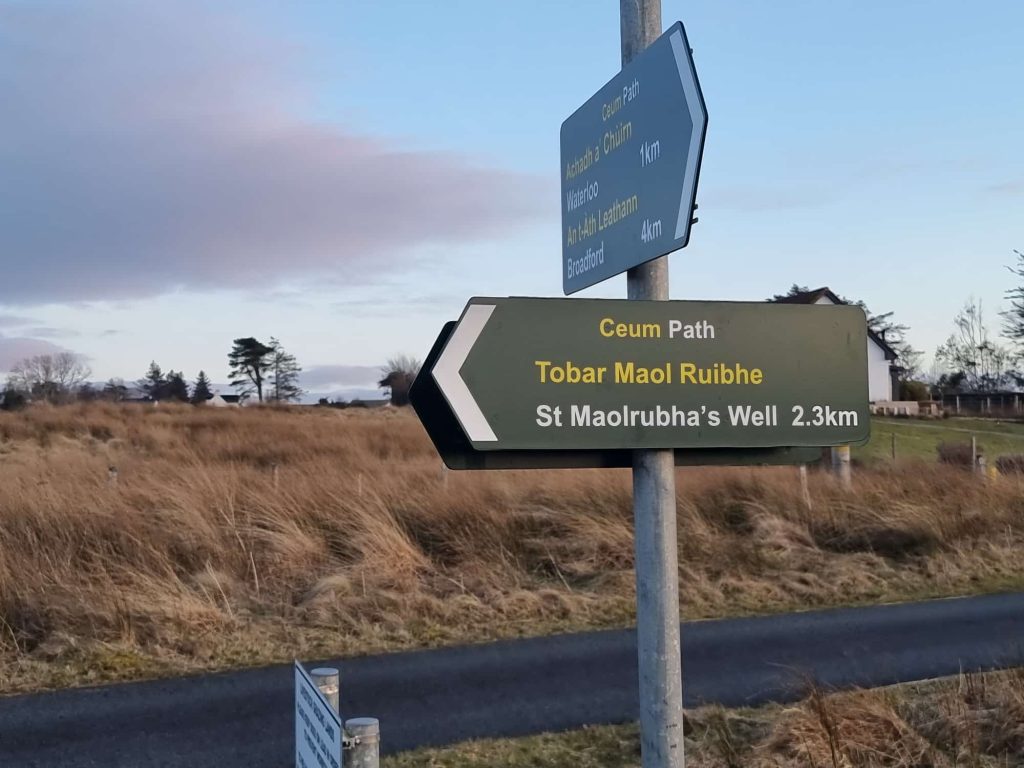
I (Chris) am on Skye just now, where we will be setting up a pop up gallery space and visiting my son-in-law’s family. They live on a croft, just along from Saint Maelrubha, second most venerated Scottish saint after St Columba himself. Maelrubha was another Irish monk, who made the journey over here 100 years or so after Columba, setting up a monastic community in what is now Appelcross, just over the water from where I now sit. In fact, legend has it that when he came over to Skye to spread the gospel, he did so by sailing over on a flat stone. Here a tall rock is remembered as his pulpit and a holy well still bears his name.
The tradition of holy wells as palces of veneration and suplication is much older than the Christ story. Around the well that bears the name of Maelrubha archeologists have dig neolithic polished axes, perhaps left by earlier worshippers as a way to persuade their version of the divine, revealed to them in th elive giving sweet water.
Scholars also trace other forms of knowing through the stories that come down to us from Celtic folk memory – ones which see everything that is and has substance, everything that breathes and moves on the earth or on the sea or in the sky, as being made and held in the mind and soul of God. In this context, the holy well is different from any other well only because it is a ‘thin place’ where the membrane between us and the great divine is thinner. Every well is a holy well, but at this one, God is more transparent.
If we can learn once more to see the world this way, how might it change our relationship with the great am-ness that we are held within?
Burning bushes

The head of this pin
The hazelnut
Snake and twist of kelp in the
Surfing summer storm
The life inside bone
This feeling of home -
It is all transparence

Every pool is a
Sacred well
Every bird is
A holy dove

Moses misunderstood
Because every bush is
Burning

Chris Goan

