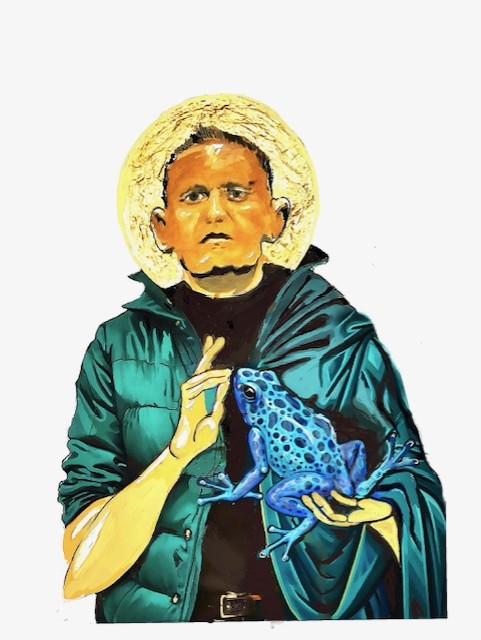
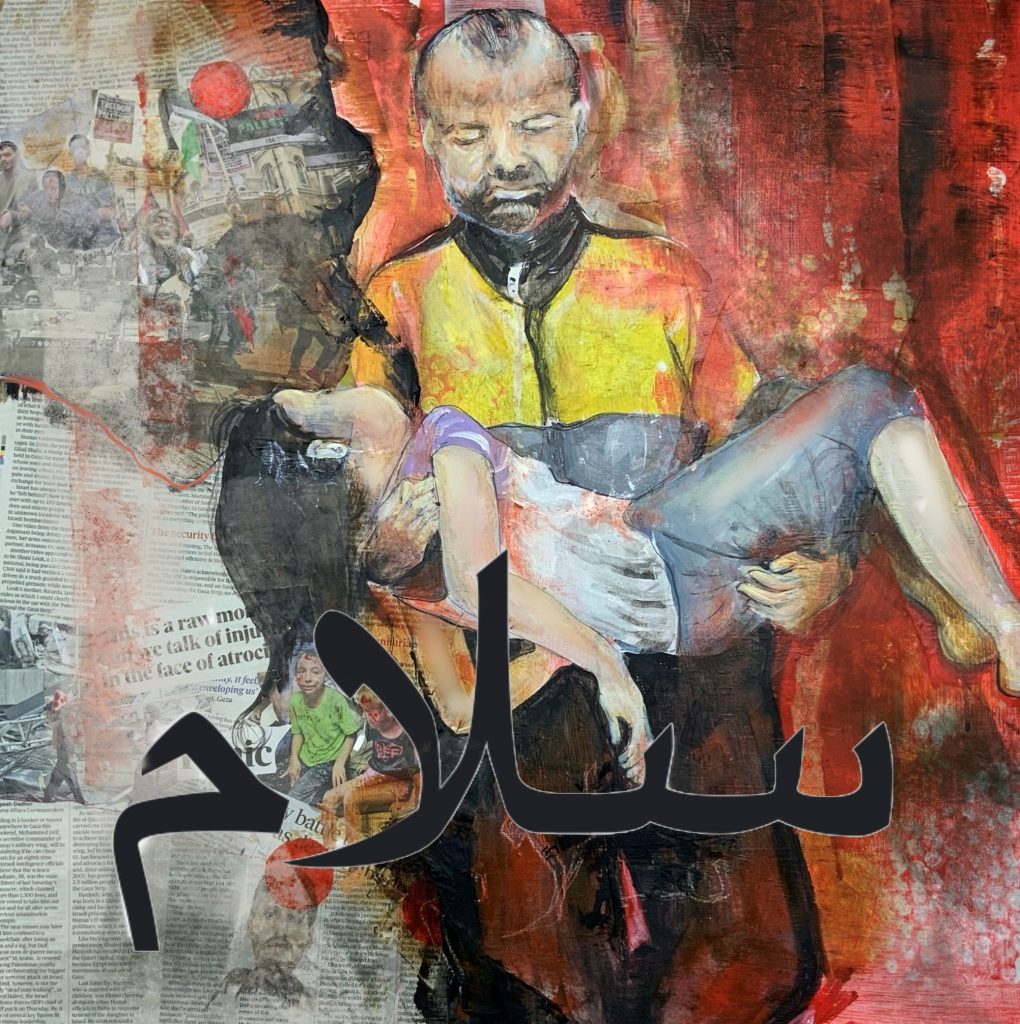
Today we are delighted to share a piece of art made by Julie Barber. It is rather wonderful in its creative exploration of spirituality and meaning through art.
Here is her description of the piece.
I’ve just been very moved by the bravery of Alexei Navalny , going back to Russia knowing what risk he took but going back any way in an attempt to challenge the corrupt regime His death coming as a result of tree frog poison . What he did felt very Christlike and loving, although I don’t know whether he he had a formal faith. I suppose I see him as a modern day saint. I recently attended a talk in Icon painting and it got me thinking about what a modern day icon might look like and this is what I came up with
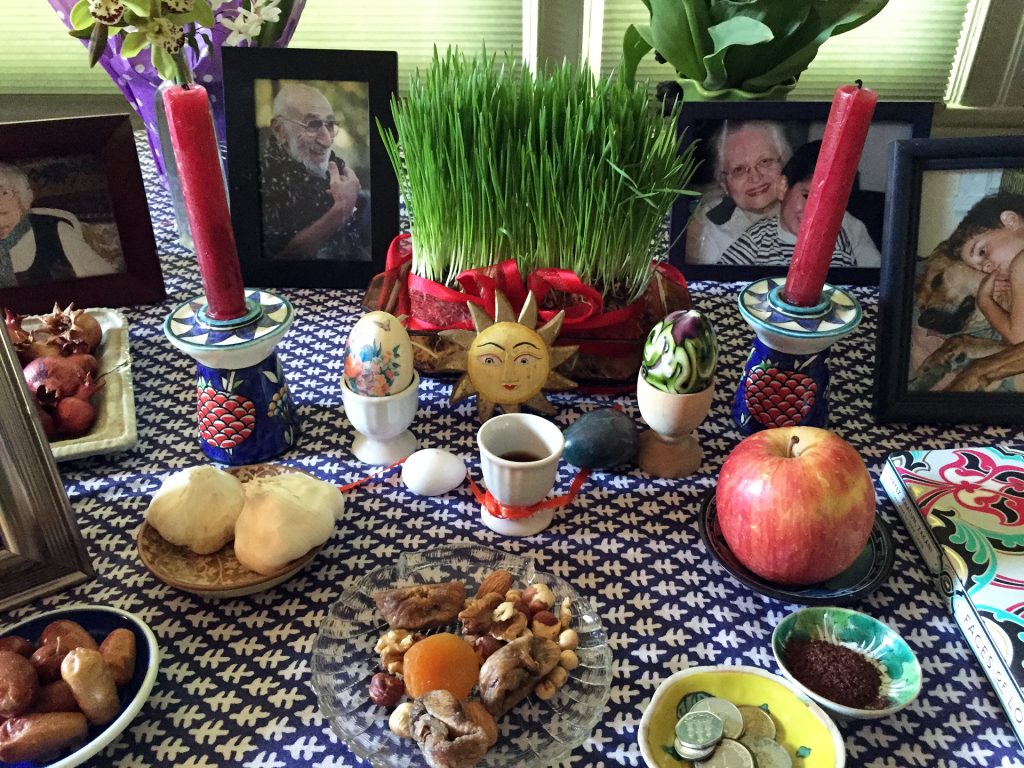
Today or tomorrow, the Iranians celebrate the first day of spring, with a 13 day festival called Norwuz.They traditionally meet together around a table, give gifts. The night before they will light a bonfire and jump over to symbolise moving from sickness (yellow) to red (flame). Think of it as their version of our Christmas, only tied in with the coming of new growth. It also involves a celebration of the new- new clothes for example – and a great big spring clean.
This year, these celebrations will be limited for most people. Travel to family, shopping for new clothes or celebratory items – none of these things are safe when bombs are falling.
So here is a challenge- why don’t we make our own versions of the Haft-sin table? Lets gather this weekend with our friends and raise a glass to those who can not. Let’s read some Hafez and imagine the spice air of Iranian night right in our living rooms.
Do it as an act of solidarity and a sign of resistance, and we should do so with some humility. Remember that the situation in Iran even before the current Netanyahu/Trump war of choice was created by our own empire meddling and swindling. Here is a good summary of this history by George Monbiot;
Iran would not be treated as an “enemy of the west” were it not for what happened in 1953, when Winston Churchill’s government persuaded the CIA to launch a coup against the popular democratic government of Mohammad Mossadegh. The UK did so because Mossadegh sought to nationalise the Anglo-Iranian Oil Company: to stop a foreign power from stealing the nation’s wealth. The US, with UK support, tried twice to overthrow him, and succeeded on the second attempt, with the help of some opportunistic ayatollahs. It reinstated the shah, Mohammad Reza Pahlavi. In 1954, the Anglo-Iranian Oil Company became British Petroleum, later BP.
Fury about the 1953 coup, combined with ever-more vicious repression under the shah’s dictatorship, triggered the revolution of 1979, which was captured by the ayatollahs, with horrible consequences for many Iranians. They would not be running the country were it not for our governments’ violent crushing of democracy for the sake of oil.
Perhaps this Hafez poem might be a good Haft-sin inclusion;
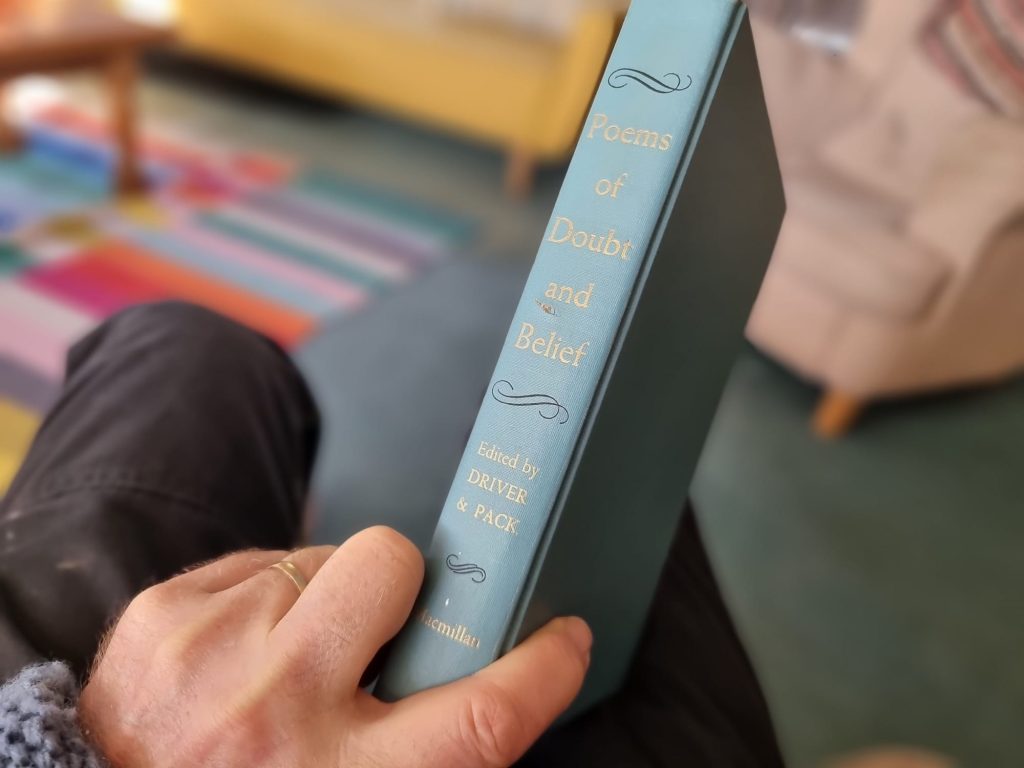
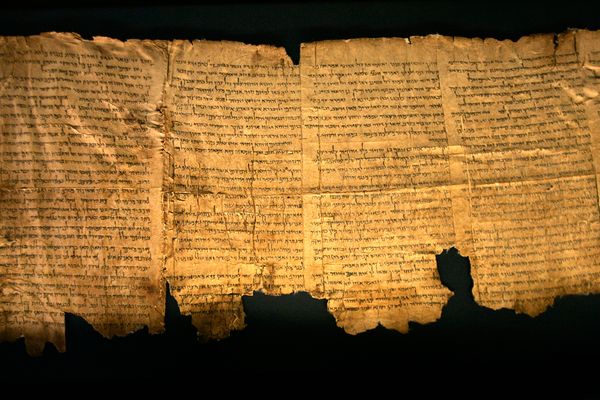
I picked up this book from a pile that were free, otherwise unwanted. I think it was part of a legacy from a previous generation of poety lovers who had passed it to a poetry club I help run. The title of the book immediately reminded me of a chapter in the Proost anthology Learning to Love, which we called faith/doubt. I wondered if someone might pick up that book
Poems of Doubt and Belief was published in 1964. What poems that we are writing now will strike people who pick up a random book in sixty years? What poems from this book might still resonate?
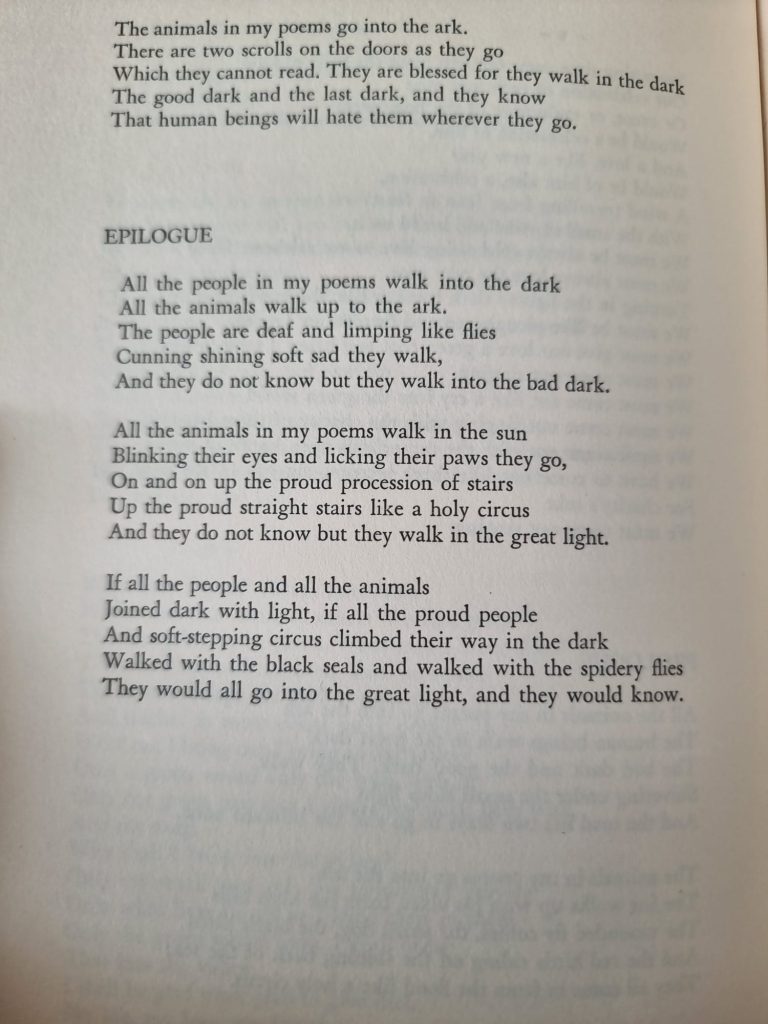
Consider the different worlds. In 1964, poets lived in the shadow of a recent world war. Perhaps they had fought or lost loved ones. The place of religion was so much more central. The wonderful thing is that through this poetry, we are taken not to their place in history, but to the immediacy of their experience, their longings, their yearnings for the divine.
Here is one random section from poem from the book called ‘They come out singing’ by the poet Jon Silkin. I loved it because it seemed to be exploring a path that I would recognise from my own journey into Celtic mysticism. But then again, that might be how I am reading it. Such is poetry.
One of the driving ideas behind this Proost revivial is the idea that we need new stories – particularly those from the margins, told by people whose unique perspective has mostly been ignored. Of course, these new stories might also be ‘old’, in that we also need to listen to the stories that have been forgotten.
Stories shape us, whether we realise it or not. Arguably the dominant stories of our age – economic, spiritual, political – are all starting to loosen their power. This is both an opportunity and a danger. We can hope for better stories, but at the same time, there is a concerted effort by some to insert stories of a much darker kind.
So it is that we see the rise of the politics of hate, backed by the spirituality of division which always seems to favour the economics of empire.
To this end, we offer you two things today. Firstly, a poem by me (Chris) in which I was trying to say the same things.
It takes a story to change the world

War breaks everything
Buildings, bones, beauty
It eats like a starving beast
Indiscriminately
But only stories change the world.

Money buys anything -
Or so it seems at first
Health, hope, houses
Even happiness has its price
But only stories change the world

Power towers above everyone
Empires rise and others fall
Men in suits send men in boots
To kick another door
But only stories change the world

Science solves our problems
Despite the odd unintended consequence
There is no gorge too wide
No ceiling above our blue sky
But only stories change the world
Next some stories from Tawona Sithole, a widely published poet playwright, and short story author. Taxona is from Zimbabwe, and is University of Glasgow’s UNESCO Artist in Residence, as well as a researcher and teacher embedded within the School of Education. Enjoy listening to stories from a different place.
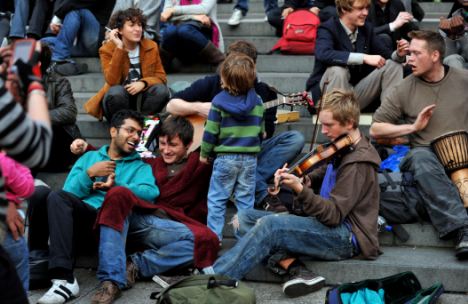
Sunday October 16, 2011. Protesters are preparing to spend their second night camped out in the grounds of St Paul’s Cathedral as part of an anti-capitalist demonstration in London.
Today another piece from Steve Page. We think his writing has grown in stature and impact, and so it is a great pleasure to celebrate this work. Here, Steve imagines a world in which we have all learned, in which we have evolved towards something that instinctively feels right, as if we finally remember that we are the children of the living god.
In the long years of anger, when sadness reached its zenith and the children were lost for words, I looked around me at the plants watered, at the canvases covered, at the manuscripts authored, at the relationships recovered.
I looked and saw that in our pain, we had turned to the crucial, away from the futile. We had become pupils, not of the brutal but of the true communal – our original design, created with hope and with love in mind. And so we had readied ourselves for the light, for the Kingdom that kept to the original divine, a fresh drawn coastline with welcome in mind. A Kingdom without borders, but with beaches and harbours, a Kingdom of refuge, where noone’s a foreigner. A Kingdom where each can rely on a King to rely on and his brand new earth, not pie in the sky or promises broken.
I looked, and I saw what I already knew, that we were past due for change from man’s empty rhetoric, that we were all full-tired of fear-filled hate preach. I looked, and I saw the waiting King, who will speak only truth to those who are listening.
Today we hear from Talitha, and her walk through forest close to her home in Australia. Let her take you with her into different country – to mine at least. Imagine the tropical sounds of the birds and the feeling of morning heat as we pace out beside her.
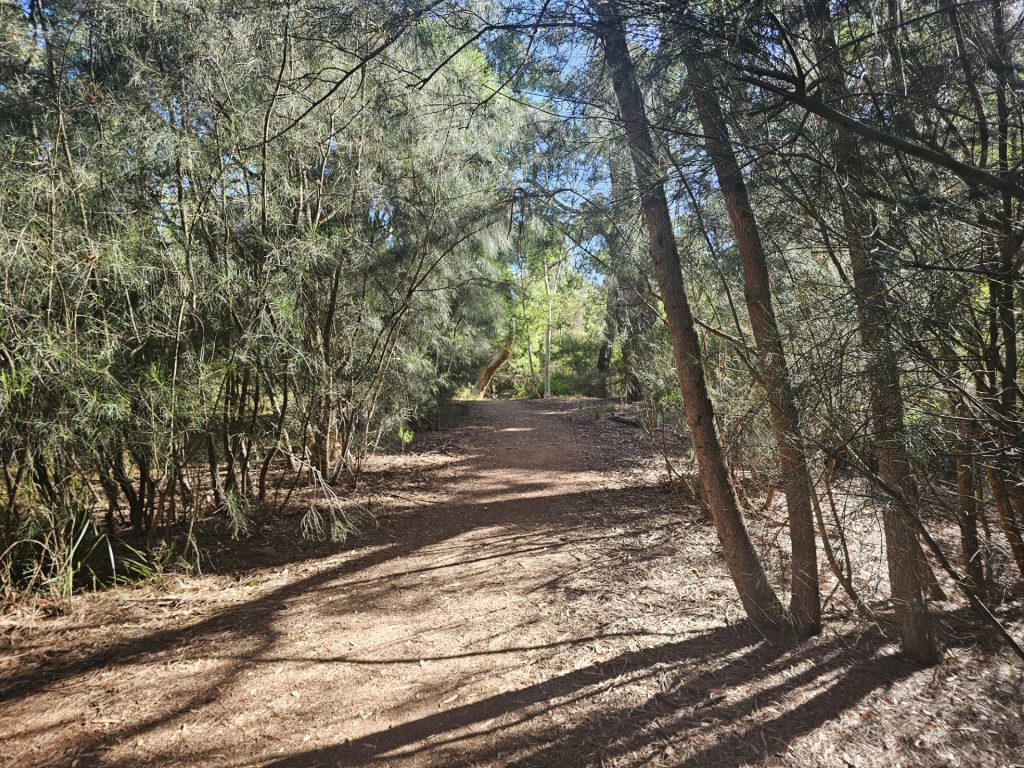
It’s the season of Luk (Eel)/Autumn in Naarm Melbourne. On my morning commute I try to make time to wander through an area of local native bush for some brief encounter with wilderness. No headphones… but rather listening to the birds and winds’ movement in the leaves and branches. No speed for my cardio as I’m passing through… but rather intentional, relational, slow presence.
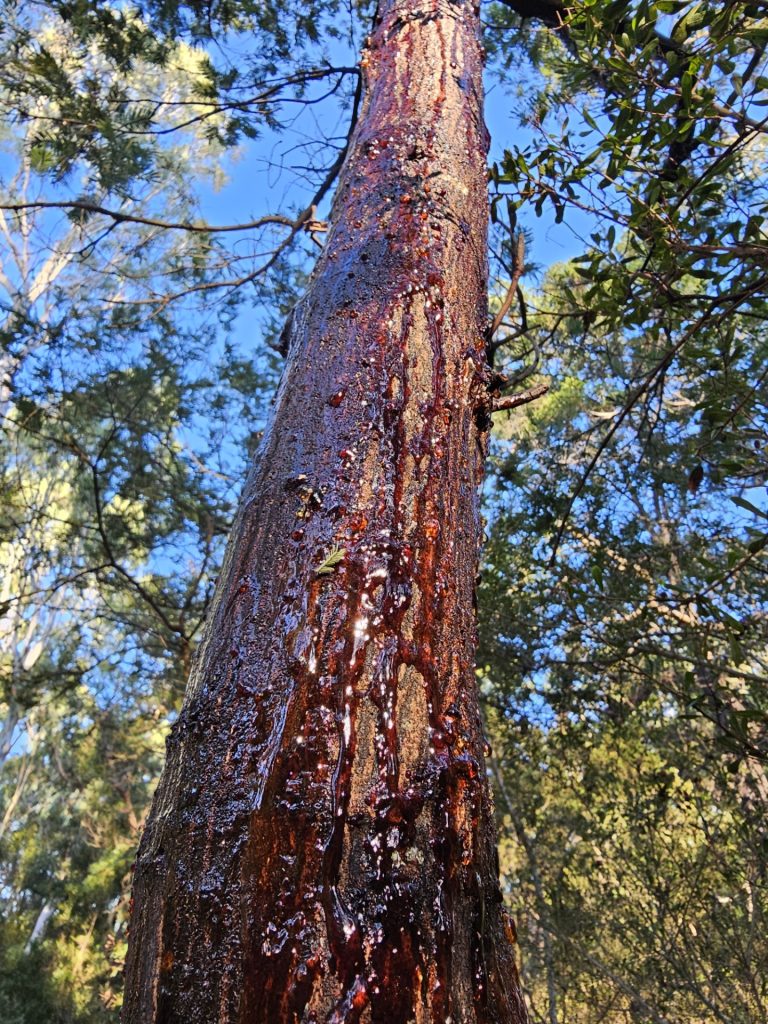
As the path curves and widens I am confronted by this tree. Is it bleeding? Do trees bleed?! …sit in contemplation of this image for a moment – what arises?
A red sap seems to pour, not from a single place of piercing, but rather the tree is awash – bleeding from everywhere, all at once.
Is it dying?
…this is a natural process. This kino (resin sap) is a way the black wattle tree can flush or bind insects that are seeking to damage or burrow under its bark.
The sap says: you are not of me, you do not serve me, you do not serve my flourishing…I’m not having with this.
The season of Lent asks this of us. To pay attention to what has slipped in and made itself at home in us bidden or unbidden.
How might you sit today – paying attention to your skin, the boundaries of your mind, heart and body… what has crept in and taken time, energy, and resources from you without your consent?
Today we have a song from Jonny Baker, referring back to an album made back in 1998 after a visit to Israel/Palestine. In the wake of recent history, they have remixed and re-released this (superb) album. We are grateful for Jonny not only for the album for for this unplugged version of one of the songs.
I have just listened to the whole album, wondering again how we allowed this history to be erased in the overwhelming telling of the story of the war in Gaza.
As Jonny asks below – who is the terrorist? What does this word even mean in an age in which terror is edited out by an AI interface, whilst simultaneously being used as a justification for genocide?
There is another way, but it requires peaceful, determinded, creative confrontation with Empire. We are grateful that art provides a means for us to do this.
Backbone was an album recorded by me (Jonny Baker) and Jon Birch after I had been on a trip to visit Israel/Palestine with Amos Trust in 1998. It was a protest album really with a mix of anger, lament and a tinge of hope telling stories of what I had witnessed. Since the Hamas attack in October 2023 and the completely disproportionate razing of Gaza to the ground and the genocide of its people, we have both watched with horror both at what has unfolded and the complete lack of intervention by the international community. Those songs we wrote back then have been on both our minds and seem sadly poignant now. So Jon has stripped back the album and completely remixed and remastered the whole thing. It stands the test of time we think but is much better sounding. We have set up a Jonnys in the Basement band camp page (jonnysinthebasement.bandcamp.com) and would love you to go and have a listen – see what you think. Do buy the album or make a donation – every single penny will go to Amos Trust for their work in Gaza.
This video of me doing an acoustic version of Terrorist was me incensed at the American and Israel bombing of Iran and the disgusting rhetoric about Epic Fury whilst wearing baseball hats sounding like teenagers playing video games. No mandate from the American people, no international mandate. Just the violence of Empire.
This is Kenmore Street in Glasgow, just around the corner from where my son and his girlfriend Rachel live. It is a street on which a remarkable act of community activism and protest took place.
Back in May 2021, a U.K. Home Office dawn raid triggered one of the most spontaneous and successful acts of civil resistance in recent memory. In Scotland’s most diverse neighbourhood, hundreds of residents rushed out on to the streets to stop the detention and deportation of their neighbours.
The morning in Glasgow, the first day of Eid, started as any other. However, when neighbours heard through community message networks that two local men were snatched up for deportation, hundreds of people left their breakfast tables, work Zoom calls, and daily lives to rush down to Kenmure Street to save them by putting their bodies on the line.
It is a remarkable story, which has become a remarkable film, patched together from interviews and phone footage taken by those who participated. It started when a man (who has decided to remain anonymous) saw what was happening, and decided he was going to take action to show his objection to the actions of the home office snatch squad and his solidarity with the two people who were being deported. He knew he would be likely be arrested, but took inspiration from the example of another Glasgow man called Brian Quail who had been arrested over forty times for protest and direction action in suppoort of peace and in opposition to nuclear weapons. Brian died a couple of weeks ago, and although I never me him, I knew him to be a man of deep Christian faith because of shared friends. One of the many moving tributes to Brian after his death can be read here.
The stort of the protest on Kenmore street will live on, beause remarkably, after 8 hours under the van, after a fierce and almost out-of-control stand-off between the local residents and police (19 minibus loads) and after interventions by human rights lawyers, the immigration officials backed down and left. later, both the people who the snatch squad were trying to apprehend and deport were granted asylum and leave to remain. It is one of those all-too-rare instances when people power led to justice and compassion. Hallelujah.
What would you have done? I wonder if I would have been brave enough to even stay on a street lined with police officers in riot gear, let along get under the van.
It is a commonly shared myth that the phrase ‘do not fear’ or similar appears in the Bible 365 times. Whilst this is not true – the actual figure being closer to 100 – there is no doubt that this is a common invocation ascribed to the divine throughout the sweep of the Christian canon. Think of Jesus calming his disciples in the stormy fishing boat, or those meetings after his death, during a time of persecution and state sponsored murder.
Why so many times? After all, the number of verses so many accept as authority for condemnation of same sex relationships amounts to perhaps three?
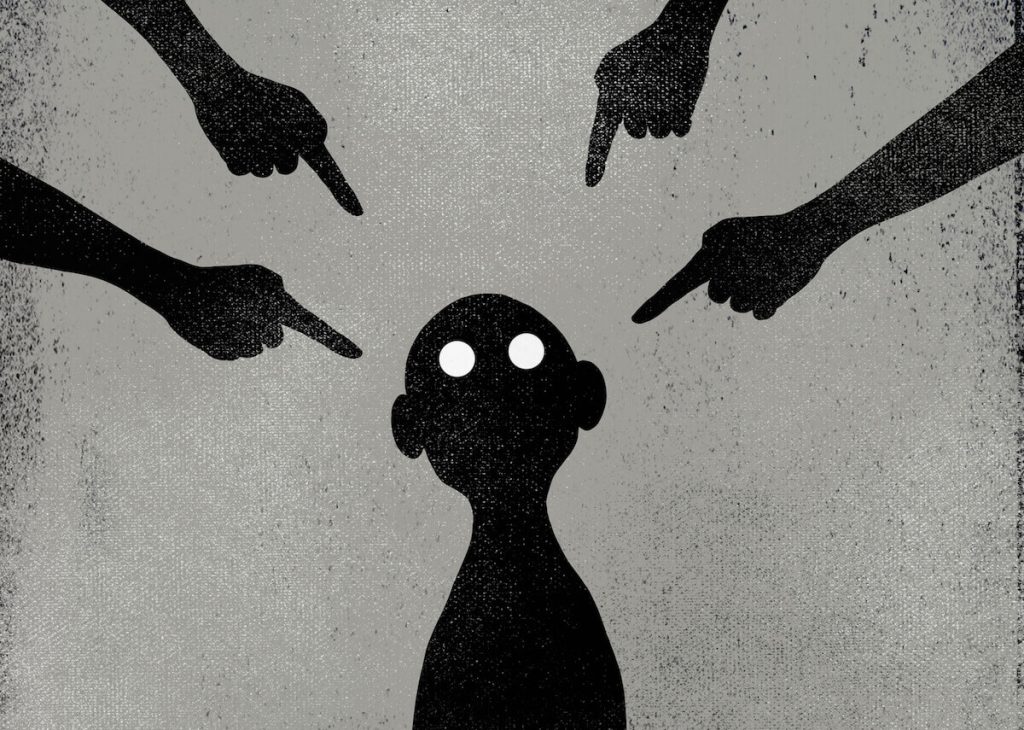
Could it be that fear is one of the most common ways that power uses to shape others to its bidding? This is true of both secular powers, with their secret police and their tanks, but also of religious powers, who set themselves up as arbiters of eternal damnation or salvation.
If we are to live towards a New Kingdom, based on justice, love and peace, we must also do so with boldness. If love is to be active, not just passive, it will always face opposition from those people or powers who object to the absurdity and generosity of love.
I think of this regularly in relation to the wars we are seeing waged in the middle east. How are they made acceptable if not by convincing people that there are reasons to be afraid? When we are afraid we appear much more willing to compromise our compassion.
What art – what substance of goodness – ever came from fear?
When we feel the shadow of fear, if we take the words of the Bible to heart, our challenge is not to seek places of walled protection, not to close down compassion, not to start a counter-offensive, but rather to once more seek the meaning of love. This feels more important than ever.
We might also learn this from another one of those Sufi poets. This time, Yunus Emre – (1241 – 1321 ce). Yunus’ poetry made a great impact on Turkish culture, but his poetry is hardly known here in the West. The poem below (and our resistence to the gospel of fear and bondage) might suggest this should change.
The drink sent down from Truth,
we drank it, glory be to God.
And we sailed over the Ocean of Power,
glory be to God.

Beyond those hills and oak woods,
beyond those vineyards and gardens,
we passed in health and joy, glory be to God.

We were dry, but we moistened.
We grew wings and became birds,
we married one another and flew,
glory be to God.

To whatever lands we came,
in whatever hearts, in all humanity,
we planted the meanings Taptuk taught us,
glory be to God.

Come here, let's make peace,
let's not be strangers to one another.
We have saddled the horse
and trained it, glory be to God.

We became a trickle that grew into a river.
We took flight and drove into the sea,
and then we overflowed, glory be to God.

We became servants at Taptuk's door.
Poor Yunus, raw and tasteless,
finally got cooked, glory be to God.

     Yunus Emre, translated by Kabir Helminski and Refik Algan - 'The Drop That Became Sea'
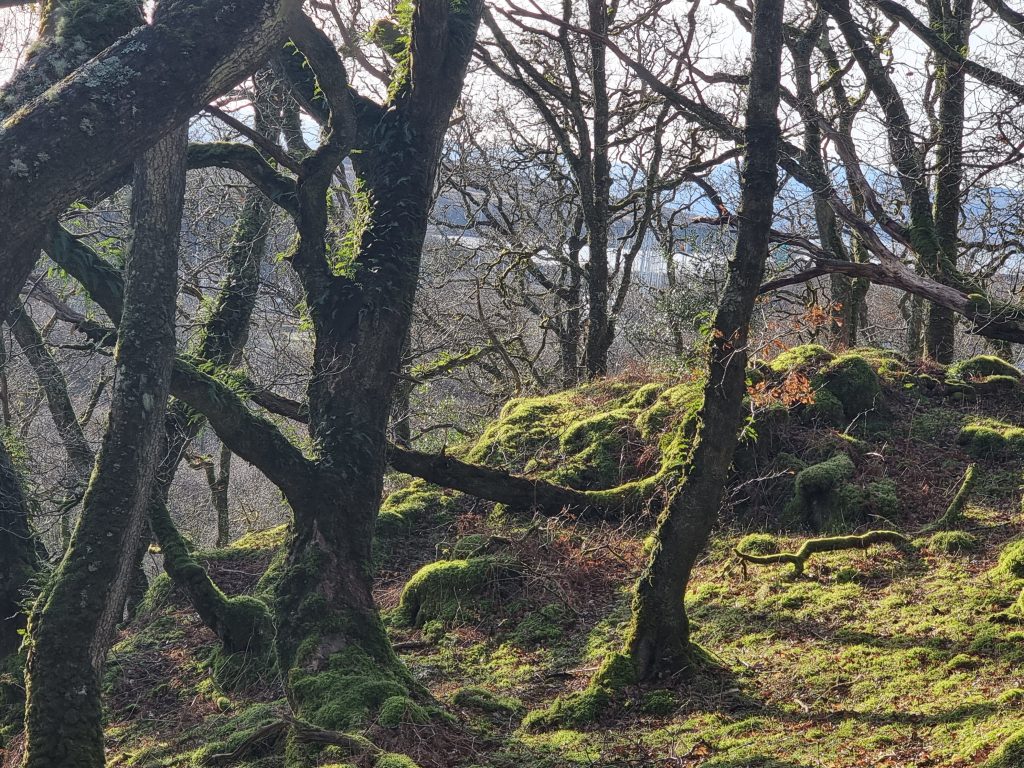
Glenan Wood, an Atlantic rainforest surviving fragment in Argyll
Yesterdy, I (Chris) had a long discussion about communion with a group of friends. We were trying to reach a shared place once again of how we might make a refreshed collective ritual around the celebration of the Christian tradition of communion. Most of us arrived at this discussion with some difficulties of what the ritual of communion had become – so often within religious spaces it reeked of pateralism, male dominance and the use of fear and power to control. Then there is the constant shadow of substitutionary attonement and how we are conditioned to see communion as a transaction in which our sin is somehow replaced by the torture and death of Jesus. Our discussion started with a rejection of this inheritance but at the same time expressed a shared longing for discovering new meanings and new forms of shared ritual chains that might lead us forward.
The room contained a wide variety of positions.
Some still carried a strong sense of the tradition that they had inherited. They were able to seperate the shadow from the light- to see the ritual as a gift of mystery. To see the cross as a symbol of ultimate self giving from a revolutionary who was prepared to give everything for what he beleived. From a God who was incarnated in our midst and lived out the best and worst of what we live. The God who invites us to participate in the great adventure. For these people, the communion ritual was still central, still vital.
Others saw communion as an invention of Paul. They saw it as an imbalance between the priestly and prophetic traditions, in which the radical call of Jesus was codified into a blood ritual. They pointed to very early documents lile the Didache in which the communion service bore no reference to this blood ritual.but rather seemed to be a shared meal- it was about feeding one another. For them, the only way they could envisage communion was in the form of this kind of shared meal- sometimes called a Agape meal.
Others were neutral- communion had simply slipped down their agenda. Some Christian traditions never made a big deal of it anyway (Church of Scotland, non conformist traditions and so on) and so they were happy to just go with the flow.
My own perspective is informed by something slightly different. The way that I am currently understanding my relationship with the living God is through the idea of her being the am-ness of all things. She lives in everything, even in me. In this context, communion is a process of recognising this reality. The Christ, even the Crucified Christ, calls me to connect with our beautiful broken earth, and this is the communion that I find most important at the moment.
We agreed in the end to accept our variety of approaches – to collectively explore different ways of making communion, seeking meaning in difference.
Here is my own communion liturgy, Imagine sharing it in the place pictured above.
Communion

BREAD
As you take the bread, describe what it means to you, right here, right now
THE REST LISTEN ONLY


This is my body
Made from the same atoms as yours
Walking the same roads that you walk
Thrilling to the same touches
Recoiling at the same pains
We are the same
We are given to each other
Woven together
Me in you
You in me
Through me, you are
Through you, I live
Together we will love.


WINE
As you take the wine, what does the word ‘redemption’ mean to you right now in this place.

This is my blood
Pumping at the soft centre
Of all things that are
Or ever were -
Or ever come into being

I am life
I am the am-ness that makes anything what it was meant to be

I am the substance sometimes known as love
That leaks and leaches into even the darkest places

Drink deep of me my friends
I am overflowing
I am poured out at this feast
I give you every last drop, so
Drink deep.
To provide the best experiences, we use technologies like cookies to store and/or access device information. Consenting to these technologies will allow us to process data such as browsing behaviour or unique IDs on this site. Not consenting or withdrawing consent may adversely affect certain features and functions.
Functional
Always active
The technical storage or access is strictly necessary for the legitimate purpose of enabling the use of a specific service explicitly requested by the subscriber or user, or for the sole purpose of carrying out the transmission of a communication over an electronic communications network.
Preferences
The technical storage or access is necessary for the legitimate purpose of storing preferences that are not requested by the subscriber or user.
Statistics
The technical storage or access that is used exclusively for statistical purposes.The technical storage or access that is used exclusively for anonymous statistical purposes. Without a subpoena, voluntary compliance on the part of your Internet Service Provider, or additional records from a third party, information stored or retrieved for this purpose alone cannot usually be used to identify you.
Improving Our Services
The technical storage or access is required to create user profiles to send advertising, or to track the user on a website or across several websites for similar marketing purposes.