Here is part 2!
Proost Podcast 18 – Part 2 of Our Wilderness Chat

Here is part 2!

Imagine stepping away from the digital world and immersing yourself in the raw beauty of a tiny Hebridean island. What if you went there with a purpose, and deliberately called it a ‘pilgrimage’? What if you split your time there between laughing with friends and times of deep silence? What impact would such a time make in your life? Would it just be a nice interlude, or might it start to shape you in more profound ways? How might relationships that you formed there impact survive back in the real world, both in terms of the divine and profane?

On our most recent retreat, back in May, I took the opportunity to ask some of my friends these questions. We went to the island of Lunga, part of the Inner Hebrides, just the other side of the ‘Grey dogs’ tidal race from its more famous neighbour, Jura. This remote location, with its sense of wild beauty, provided the perfect backdrop for our trip, and this time, the sun was shining throughout. As we explored the island, we were reminded of the rich Celtic heritage and the spiritual significance of these islands – and how they connect us with an older spiriuality that was always connected to earth in ways that we have largely forgotten.

The retreat was more than just a getaway; it was a gathering of friends, old and new. We shared stories, laughter, and deep conversations, creating a temporary community that felt like home. I have often reflected on how these people, some of whom I see only once or twice a year, have become for me a kind of Anam Cara- deep soul-friends of the kind that ‘know’ me in ways that it is impossible to fully describe. Some of this is fostered by the island – the exposure and shared need for each other it places in us but also by the raw uncouth toilet humour that has two superpowers – it is very funny, but also strips out all pretense.
These video’s were recorded in a hurry, right at the end of our trip, as I it felt like an imposition, an indulgence. I am very grateful that some of my friends were gracious enough to take part.
There are two ways to watch/hear the chat…
By podcast
Or I uploaded the vid to Youtube here

You may remember previous articles and even podcast interviews with Dr. Katie Cross, who has been undertaking research trying to understand paths taken by people who leave church- the meaning they make and find, the connections they still seek and so on.
Katy is now towards the end of her research, and is entering a ‘creative response’ stage. There are a few ways you can be involved, but the first meeting on-line is Tuesday the 29th at 6PM. If you are on your own journey beyond church, but feel like understanding this better in community then this might be just the place for you.
There are two ways folk can take part:
As above, the first group is meeting on Tuesday 29th July at 6pm on MS Teams.
We hope that Katie will be able to join us on the Proost podcast soon to collect together some thoughts and conclusions about this very important research.
Why do I think this chat is so important? As with this post, there is lots of chat just now about what is emerging in terms of organised religion in the UK. After a long decline, some say (on currently very limited evidence) that there is a ‘quiet revival’ taking place here, with young people, and young men in particular, flocking back into Churches. If this is true – if we are seeing a reversal of the decades-long social trend away from organised religion – then it seems important to understand this and the social forces that might be at work.
On the other hand (and at present I remain in this camp) if this research turns out to be flawed, we also need to understand why so many people within the Church have seized on it with such uncritical enthusiasm.
Meanwhile there is another conversation that is taking place – for example in Katy’s research – with those who have been activists, leaders and pioneers within the church, but no longer feel able to be part of formal religious structures. What happened ot these people? Where are they finding meaning? How might they shape and influence what happens next?

Even as I write this, I think too of dear friends who continue to work WITHIN the Church, to carry forward acts of grace and mercy, to serve an aging population with critical needs, to run food banks and toddler groups, to set up refugee support groups and to make simple beautiful acts of worship that enable people to deepen their spiritual experience. I think how exhausted some of them are, and how abandoned the conversation above makes them feel…
Things are changing, shifting, shrinking and unfolding at the same time. This has always been the case, but it does feel like we are standing on anther threshold. Whilst we mourn what is lost, we can also be excited about what will come.
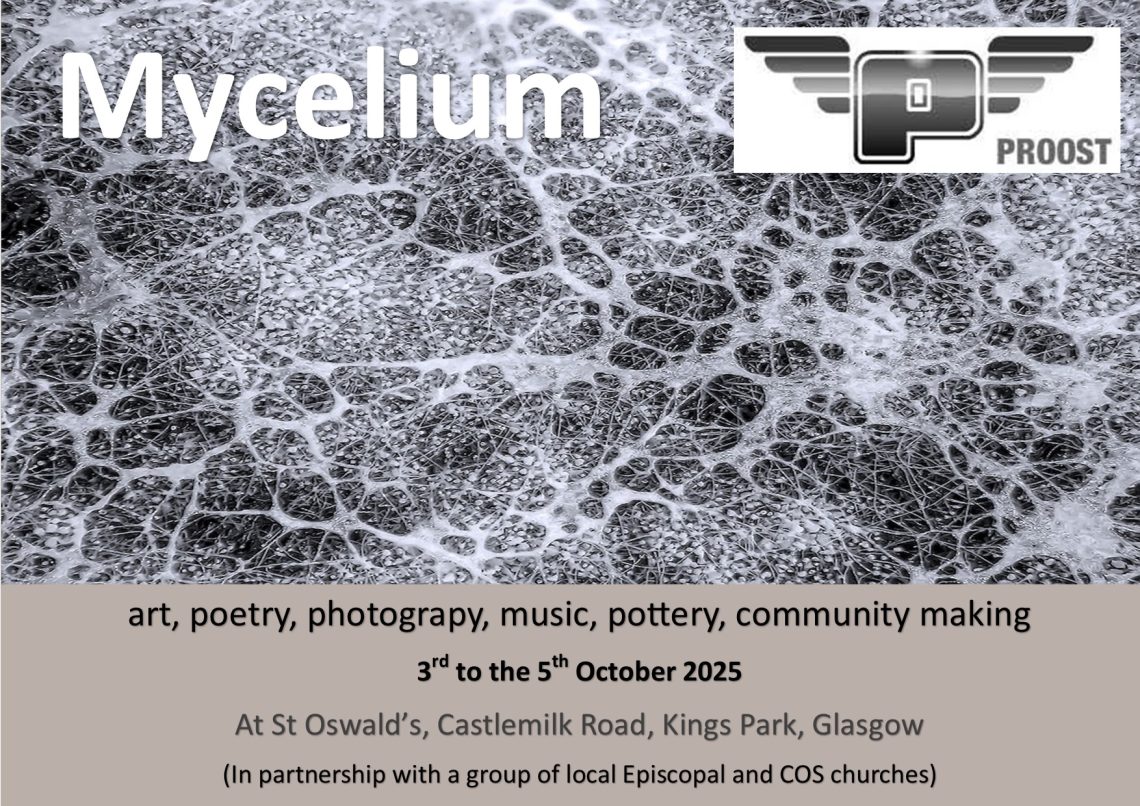
We are going to be using this blog space to post material related to the theme of our Proost meet-up in Glasgow this October. Consider it inspiration for your own art making and imagining.
Today, lets talk about forest…
We are going to be using this blog space to post material related to the theme of our Proost meet-up in Glasgow this October. Consider it inspiration for your own art making and imagining.
This might be the best place to start… sit down and enjoy this lovely film.
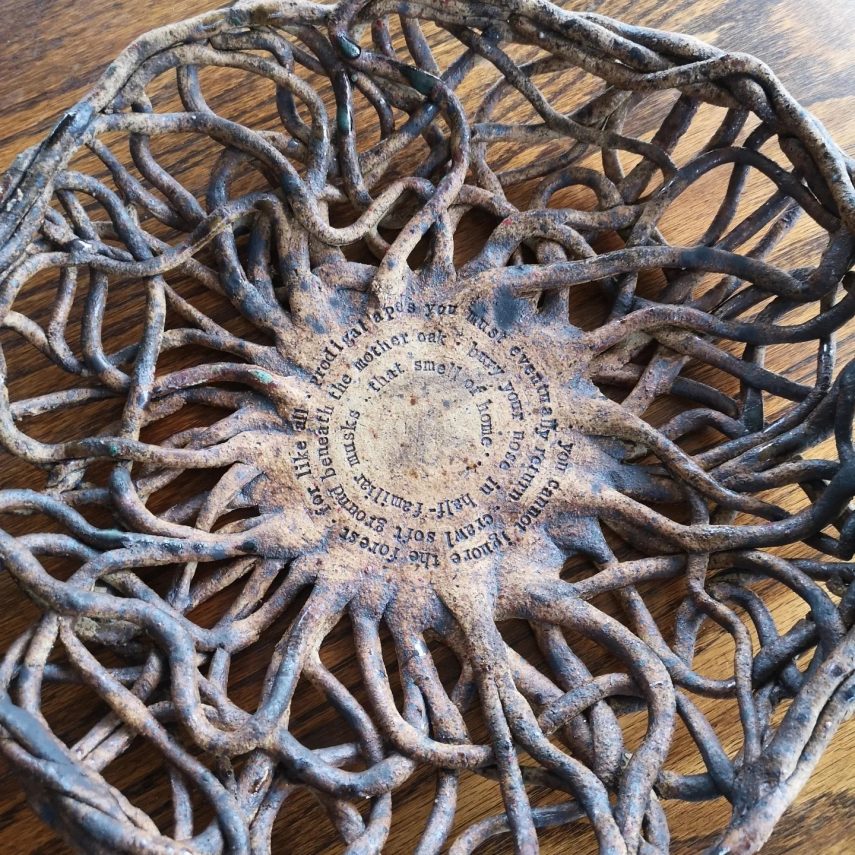
Here is a quick update on the Proost meet up for artists in Glasgow. First, the key details;
PROOST MEET UP, 2025
Date: 3rd October 2025 (6:00 PM) to 5th October 2025 (4:00 PM)
Location: St Oswald’s Episcopal Church, King’s Park, 260 Castlemilk Rd, Glasgow G44 4LB
Hosted by: Proost, in partnership with local Episcopal and Church of Scotland Churches
Cost: The gathering is free, with the aim of making this gathering as accessible as possible for all.
Accommodation: Informal hosting options are available for those who need them, and we’re happy to provide guidance on nearby accommodation options to help you make your stay as comfortable as possible. Let us know how we can assist you!

WHAT IS IT ALL ABOUT?
Many of you will remember Proost as it used to be- a publishing platform established on the edge of what we used to call ’emerging church’ or ‘missional groups’ or ‘alt worship’. It gathered a community of creatives who made poetry, art, video, music, liturgy and much more. For many of us, it gave a sense of belonging and connection – and ways to collaborate with other artists in both gathered and dispersed events. We live in different times now, but if anything, creatives need these connections more than ever.
We need art that engages, that challenges, that allows us to go deeper.
We need to hear from people who are otherwise marginalised.
We need to speak of justice and peace, so challenge where appropriate.
We need to take allow our art to connect with the deep spirituality of the earth.
The landscape of faith and culture has changed a lot in the decades since Proost first came on to the scene. Communication technology has made publishing easier, yet at the same time so much harder because of the sheer volume of content being produced. Funding streams and generating income is a massive challenge. Against all this, we have a powerful tool called community.
This is our dream for a new Proost- the means by which we combine our voices, our creativity and our resources to transcend the limitiations imposed by our context in service of justice. We think this is a holy pursuit, made ever more urgent by the crises gathering around us- wars, climate breakdown, inequality and political/economic impotence.
Much of this discussion has been taking place via two podcasts…
… and we have made a start with some collaborations around Advent and Lent.
But we feel that community also needs to make physical connections. We need to come together in one place, to share stories, to make plans and art together.
WHAT WILL WE DO?
The idea is simple- choose a theme and then invite people to respond to it using their art – music, poetry, painting, dance, pottery, photography, animation, video – or anything else.
We will make space for as many contributions and expressions of creativity as we can comb together in the form of installation or performance. The only limitation is that you need to bring those contributions in person!
We are so grateful to St Oswald’s Episcopal Church (King’s Park, 260 Castlemilk Rd, Glasgow G44 4LB) in partnership with local Episcopal and Church of Scotland Churches for generously hosting this weekend.
Installation space will be in and around the St Oswalds. (This will include a large mushroom-related ceramic offering!)
Performance opportunities will be via 1. A great big Ceilidh on Saturday night – dancing, hopefully interspersed with all sorts of other poems, songs and stories. 2. Sunday afternoon event. Both will be open to local people.
We want to keep Saturday day-time for discussion and chat amongst Proostians – working out together what seems important, and how this project might progress. There will be themed discussions led by different members of the team.

WHY MYCELLIUM?
This is the theme we have chosen for our meet up. Some of the reasons for this will already be in your heads, but here are some ponderings that might help unleash your own creative responses.
Soil science is advancing rapidly – we now need to stop thinking of soil as just inert dirt. It might be more accurate to regard it as a living entity all on its own – but if that is a little fanciful surely we need to understand that it is a complex ecosystem- one which almost all other land based life on the planet depends upon. Without soil, we die. Crucially, the role of mycelial networks in connecting, communicating and making communalities is increasingly being understood to be so much more important than previously thought.
Mycelium is the way that trees ‘talk’ to one another. Think about that- one life form relies upon another lifeform in order to share nutrients, warn of disease and so much more.
We modern humans tend to think about the natural world as being characterised by competition, the elimination of weakness and ‘survival of the fittest’. We have taken Darwinian ideas, misunderstood them and used them to justify our economics, our politics – even our spiritualities. The more we understand about mycelium, the more we need to think again.
Perhaps the ‘survival of the fittest’ might better be understood to mean that we survive best when we seek to fit with our context – when we seek connection and community.
What are we connecting with? Does mycelium only represent a way to understand human interrelatedness – with both each other and with the wider natural world? I would argue however that we might consider this connection to be much deeper than that.
These ideas have always been at the heart of the Christian story, not least the mystical traditions and the Celtic wisdom traditions, both of which have long emphasised that it is through God that all things live and have their being. In the Celtic understanding, God is to be found at the centre of everything, even us. We encounter him by going deeper.
Richard Rohr, in his magnificent book ‘The Universal Christ’ show us a different window into this way of understanding, in which the Christ is ‘another name for everything’ – the cosmic consciousness through which the universe expanded and came into being. We are all held in this commonality and invited to participate according to the deep truth of love.
As followers of Jesus, there seem to me to be so many other resonances here.
Jesus called for a unified community, where individuals, despite their differences, are “perfectly joined together” in their minds and judgments.
He used the image of a body with many parts, each playing a vital role, to illustrate the interconnectedness and interdependence of his followers.
Jesus emphasized the importance of loving one’s neighbour as oneself, which encourages cooperation and mutual support within a community. Compassion and love are a natural law that we need to be drawn towards.
He demonstrated the importance of serving others, highlighting the value of helping those in need and working together for a common good.
Jesus encouraged his followers to work together, emphasizing the importance of partnership in living as agents of the Kingdom of God.

HOW TO GET INVOLVED?
We need ideas, songs, poems, film, images, dance, liturgies. We will ‘curate’ these in advance and include as many as we can. HOWEVER- this is about community, so we need you to bring your ideas, not just to send them. We will make the event together.
We have some very limited funding, and the offer of some accommodation. We don’t want money to be an obstacle for anyone.
This is the start of a new thing. Come and help shape it. On saturday we want to explore ideas together- to talk of Poesis and dream of how art and spirituality move togther and miight lead us forward.
If this is interesting to you, what you can do is
SIGN UP VIA THE PROOST WEBSITE
This will not commit you to anything- we will keep you informed, that is all.
If you have ideas you want to talk through,or want to know more, or have questions, we would love to hear from you- you can get in touch via the website, or drop me a message via the comments below, or send me an e-mail at thisfragiletent@com

This talk pretty much underlines the reason for our revival of Proost!


I have just listened to the latest Proost poetry podcast, this time, a conversation between Proost’s Talitha Fraser and the poet/dancer/coreographer/community psychologist/filmmaker Justina Grayman. It is one of those conversations that you just have to let wash over you- full of deep insight and beautiful poetry.
As well as her poetry, Justina makes art like this:
You should check out Justina’s website for other poems, dance films and perhaps the best – most creative – profile I have ever read.
You can listen to the podcast here:

This journey ends.
Many others begin.
Poetry has been a central part of the Proost lent journey, so it seems entirely appropriate to end this one with a final glorious burst. To this end, we offer this Proost Poetry Podcast recording…
We are so grateful to Hannah Caroe and Tim Watson for their contribution to this podcast.
For those who avoid Spotify—we are working on alternative hosting, but in the meantime, I uploaded this chat to YouTube as well.
Here are the poems featured in this chat..
HANNAH’S POEMS
Loss
Careless, perhaps
to lose a mummy
and a daddy.
It was complicated, but
I loved them so.
Grief is a funny thing
(with feathers?)
Are they true,
the prophet’s words?
‘The deeper your cup
is carved with pain
the more joy you can contain’.
I’d like to think so.
Certainly
the work of grief
connects us
with hidden life inside.
So we can know
‘life in all
its fullness’.
We all love
so we all know grief
We’re all, it seems
losing our
bright and brimming
beautiful
Earth.
Grieve with us,
Lord.
May we together
weep new rivers
(rushing, clear
and filled with salmon)
new seas
(with icebergs
and teeming reefs)
and a new world.
.
A vase of bluebells on Good Friday
Plucked minutes ago
bowing
at Your head hung low.
Gathered
in my parents’ milk jug
each flower bashful almost
amongst so many.
Beyond the window
a leaden sky hangs:
today’s daytime darkness.
In three days You rise –
we are the blessed ones
knowing this. But
for now
in that hellish hinge
of history and place
hope is eviscerated.
And it is night.
.
Cornwall: sea haar 16.10.24
Tamarisk leaves
(fragile, sea-green)
lined with mist’s dampness.
Waves breathe in attendant air.
Piskies, Bessy’s, Kenneggy.
The end of Cudden Point
(ponies’ home). A creased-map
landmark
we know is there
but cannot now see.
Rooks. Seagulls
wing the morning.
Here, nigh at Land’s
End, have we come to
the end of all we know?
Beware!
beyond lie: dragons
dolphins?
dreams…
TIM’S POEMS
Weeds (part of the Storm Rage Fire Burn poetry project)
The weeds will overtake us
as we run and there will be
no place left to hide
no place left to us
for we have sold our treasure
for the spoils of a moment
and the memory of the ear
this longer than even
our greatest dreams
.
On Discernment
It is a process of becoming
Of patiently unearthing
Timeless etchings and markings
Hidden deep withinTracing fine lines
Streams of living water
Seeping through clay and dust and skin
It is a following of sorts
Quieter than we are used to
With no assurance
Of where it will one day lead
CHRIS’S POEMS
Christus
Not Messiah, but memory –
You are what we once forgot.
Woodsmoke.
A curve of earth
Towards completeness.
Not God, but goodness –
You are what we left behind.
Compost.
A fecundity of light
Awakes this forest floor.
Not Risen, but wide open –
We are not just the sum of skin.
Mycelium.
An animal whom, despite of evolution
Finds value most in kindness.
Not Saviour but revelator –
We search the stars in vain.
Insemination.
A pulse pounds insistently when
There should by rights be silence
.
Golgotha
It was not the end you’d want
But (as it turned out) it was no end at all
Instead, flowers still grew,
Birds still sang
Children still laughed
The still-moon dipped it’s still rim
Into the still-blue sea of Galilee.
It was a terrible place to die
But (as it turned out) we did not die at all
Instead, we stood waist-deep
Reeking from the worst of what
Old Golgotha was, and
We were not consumed
We were not doomed.
It was a place of no return
But (as it turned out) return indeed we did
To the garden that grew us
To the mother that made us
To the brother who broke us
To the spirit that woke us
In our Golgotha

Holy Saturday (or Dark Saturday) is traditionally a day of waiting, prayer and fasting. Symbolically, Christians wait at the tomb in which Jesus was buried, meditating on his Passion and Death and anticipating resurrection. Mass is not celebrated on Holy Saturday. Candles remain extinguished and altars remain bare.
What are we waiting for? Why do we fast? What desperate prayers are we intoning? What life is possible after death?
The Easter story is so familiar to most of us that perhaps it is easy to dismiss the defeat of this Saturday. This was, after all, when everything had already ended. The good people had lost and the bad ones hardly noticed. All hope had been replaced by… extinction.
Whatever your theories of atonement and however you understand the history or mythology of the resurrection, today let us just remember that it all ended.
Perhaps this might help too. Katie Cross pointed us towards this picture:

This is Georgia O’Keeffe’s ‘Grey Cross on Blue’, which Katie had encountered in a museum in New Mexico.

O’Keeffe was painting in the 1920’s, on a search for an older, more authentic America. The wild lanscape of New Mexico, often split by the many crosses of all shapes and sizes that had been erected there, was a constant theme of her painting. Beyond the cross, there is something else however…
The blue reflects the sky and the Blue Lake or Ba Whyea, an ancient sacred site for the Native American Taos Pueblo community: taospueblo.com/blue-lake/
It was not until the 1970’s that this sacred site was returned to the Taos people.
President Nixon stated, “This is a bill that represents justice, because in 1906 an injustice was done in which land involved in this bill, 48,000 acres, was taken from the Indians involved, the Taos Pueblo Indians.
The Congress of the United States now returns that land to whom it belongs … I can’t think of anything more appropriate or any action that could make me more proud as President of the United States.”
That signing restored Taos Pueblo lands and led to the unhindered continuation of the Pueblo’s millenniums-old traditional culture. It also set a precedent for self-determination for all American Indian people, tribes and nations.
Here is a story of death.
Here is a kind of resurrection.
 Spotify